
Skill Creative Problem Solving Turn your team’s problems into ideas on demand.
Creative thinking and problem-solving training for teams and students. Learn design thinking fundamentals, brainstorming and creative problem-solving tools, and use them on a real challenge from your work or studies.
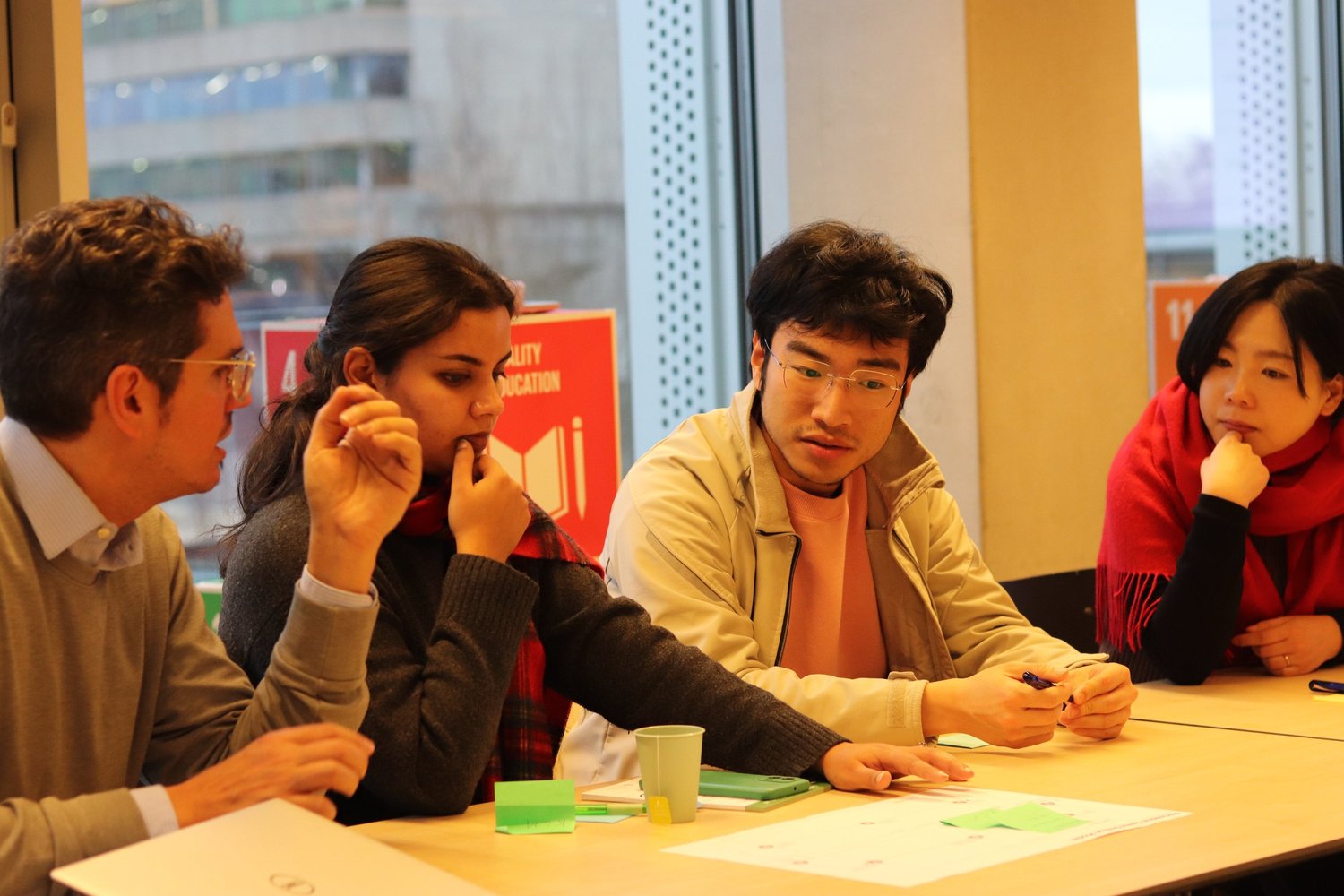
Why it matters.
New problems rarely come with a manual. Teams that can generate options and test ideas quickly find better solutions.
Creativity isn’t a talent you either have or don’t. It’s a set of habits you can practise, from brainstorming to looking at a problem from another angle.
A review of 70 studies found that creativity training tends to improve creative performance, especially when it teaches practical thinking techniques. It supports the approach we use; it doesn’t measure our own results.
Source: Scott, Leritz & Mumford (2004), Creativity Research Journal ↗Two frameworks, one creative process.
Design thinking fundamentals and creative problem solving. We help you choose the one that fits your challenge.
Creative problem solving
A structured way to tackle problems with creativity and critical thinking. Broad and flexible, it works for everyday problems at work, in business and in personal development, alone or as a team.
ModulesYou, creativity and biases · Introduction to creative problem solving · Problem finding · Idea finding · Solution finding
Design thinking
A variation of creative problem solving built around the people you design for. It uses empathy and collaboration to find products, services or solutions that meet real needs, and suits larger, open-ended challenges.
ModulesIntroduction to design thinking · Empathise and define · Ideate · Prototype and test
This is practical, introductory training: design thinking for beginners and for teams that want to use it at work. It isn’t a specialist design qualification.
What you’ll practise.
Every course and workshop follows the same creative process, from understanding the problem to testing a solution.
Rethink your creative potential
Explore your relationship with creativity, the hidden biases that limit new ideas, and a growth mindset you can keep building.
Find the problem behind the problem
Question assumptions and reframe your challenge, so you solve the right problem.
Generate and choose ideas
Brainstorming, mind mapping and tools like SCAMPER, switching between divergent and convergent thinking.
Make ideas tangible
Build a quick prototype, pitch your solution and plan how to test it.
Learn by doing: interactive exercises, real-world cases and group work. See our method →
Go wide, then narrow down.
Creative problem solving switches between two kinds of thinking: divergent and convergent. Our courses and workshops teach both, and when to use each.
Go wide
Generate as many ideas as you can and hold back judgement. Tools like brainstorming, mind mapping and SCAMPER help you get past the first obvious answer.
Narrow down
Evaluate, combine and prioritise the ideas, then choose the ones worth prototyping and testing.
You switch between the two at every step: to define the problem, to find ideas and to choose a solution. Keeping them apart is the habit we train: no judging while you go wide, no new ideas while you choose.
Ways to train.
Workshops for teams and students, in three formats.
Design thinking and creative problem-solving courses
Four or five modules of 2 to 2.5 hours for your team, built around a real challenge. For students: a 6-week Creative Thinking and Problem Solving course, or a Design Thinking & Innovation masterclass of three 2.5-hour sessions.
Workshops from our catalogue
A 2-hour creative problem-solving workshop (1.5 hours is also possible) for your team, an event or a student group: a brainstorming workshop with a clear process behind it.
A tailored solution
We help you choose between creative problem solving and design thinking for your challenge, and can combine the modules with communication or presentation skills.
Bring a challenge from your work or studies.
In our courses you work on one real case from start to finish, and we help you pick the framework that fits it. Challenges participants bring include:
Meet your trainers.

Matt Hrusc

Alberto Quirico
Questions?
What is design thinking, and how does it relate to creative thinking?
Creative problem solving is a structured way to tackle problems with creativity and critical thinking. Design thinking is a variation of it, built around the people you design for: you empathise, define the problem, generate ideas, then prototype and test. Both rely on creative thinking skills you can train.
What does the introductory module cover?
It sets the foundation: your relationship with creativity, the biases that limit new ideas, and the core steps of creative problem solving or design thinking, including divergent and convergent thinking. You also look for places to use the framework in your own work or studies.
Do participants need previous experience?
No. This is design thinking for beginners: our workshops introduce the basic methods, for early- to mid-career professionals, students and recent alumni.
Can the workshop address a real challenge our team faces?
Yes. In our courses, participants work on one work-related case or challenge throughout the modules, and we help you choose the framework that fits it. See our company training or training for universities.
Is training delivered in English?
Yes. Our design thinking training is in English by default, and we can also deliver it in Dutch.
How long is a workshop, and how many people can join?
A workshop takes 2 hours, and 1.5 hours is also possible. We recommend up to 16 participants, with a minimum of 8. Course modules take 2 to 2.5 hours, with 4 to 10 people per class.
Is this a design thinking certification?
No. It’s practical, introductory training, not a specialist qualification. Courses of four or more sessions include a LifeVersity certificate of completion when you attend at least 80% and complete the module assignments.
Ready to grow?
Book a free call and we’ll help you find the right training for you or your team.